The Logical Necessity of a Substrateless World · Chapter 13 · Part V
Conceptual Designation vs. Mere Naming
Part V Overview: Part V explores how conventional reality coheres and functions without a substrate. Having established that intrinsic essences are logically impossible, this final part demonstrates that boundaries, entities, and scientific laws do not depend on solid ontological cores. Instead, conventional boundaries are drawn by conceptual designation and hold because they prove reliable in use, while scientific inquiry is reframed from a search for ultimate 'building blocks' into the rigorous modelling of regularities within designated frameworks—regularities that are themselves designated, not a ground beneath appearances.
Conceptual Designation Is Not Arbitrary Nominalism
A primary point of confusion in non-foundationalist philosophy is the collapse of conceptual designation (prajñapti) into superficial nominalism or linguistic nihilism.
Under naive nominalism, names are assumed to be arbitrary verbal tags slapped onto a chaotic or subjective world. On this view, because things lack intrinsic essence, their designations are entirely subjective and unconstrained.
The two must be kept apart. Mere naming would be an unconstrained label, attached without regard to anything it meets. Conceptual designation is the picking out of something as this rather than that—by perception, by concept or by language—constrained at every step by what holds up under further experience.
We cannot designate a shadow as a bridge and walk across it, nor can we designate liquid water as a solid cutting blade. Conventions are not arbitrary fictions because, within the framework in which they are made, they hold up or fail under further experience; cause, effect and the regularity between them are designated together, not patterns given in advance for designation to copy.
Framing Patterns Without Pre-Existing Objects
In a substantialist framework, a concept is believed to point toward a pre-existing 'noun'—an independent entity whose boundaries were drawn by nature prior to observation. But when such boundaries are looked for, none is found from its own side.
Consider a forest. Where does it end and the surrounding land begin? Walk out from its centre and the trees thin, give way to scrub, to a scattered copse, to a field with a single oak. No line in the ground marks the edge. And if the forest itself is sought apart from its trees, soil, fungi, air, microclimate and light, nothing remains to be found. The whirlpool of the Introduction is the same: unmistakable in the river, yet no whirlpool-substance sits beneath the water passing through it.
Yet neither the forest nor the whirlpool is a hallucination. Conceptual designation draws a conventional perimeter, guided by use, contrast and the scale of observation. The pattern framed is no more given in advance than the boundary: pattern and framing are designated together. What keeps the designation from being arbitrary is not a pattern established from its own side, but its reliability in use.
Designation Is Not a Sticker
When the mind hears the word 'designation', it pictures stickers. There is a jar on the shelf; someone writes 'sugar' on a label and presses it on. The jar was there before the label, the label adds a name and nothing else, and if it is peeled off the jar is just as it was. Applied to the world at large, the picture is reassuring and wrong. It keeps, under the label, exactly what this book has refused: a pre-given object, finished before anyone names it, waiting underneath.
Without pre-given objects there is nothing for the sticker to stick to. Designation is then not laid on top of an appearance; it is in the very appearing. Look up from this page at a cup on the table. It does not first appear as a patch of colour and curved shape that is afterwards labelled 'cup'. It appears as a cup—already something to lift, already something to drink from, its handle already offering itself to the fingers. The coldness of the ice in Chapter 5 did not arrive as raw sensation awaiting a name; it arrived as cold, as sting, as something to pull the hand away from. Try to strip the designation off and find the bare appearance underneath, and nothing bare is found. Try to take the vividness away and keep the designation, and the 'label' has nothing left to say.
Designation and vividness are therefore mingled through and through, with no seam between them and no hierarchy. There is no real layer of sensation underneath and a merely conceptual layer of naming on top, because there is no substrate to hold the two apart or to rank one below the other. Tsongkhapa makes the point at the root: even the basis on which something is designated (gdags gzhi) is itself merely designated, so that designation never bottoms out in something given (Ocean of Reasoning, on MMK 24.18). Wilfrid Sellars's attack on 'the Myth of the Given' reaches a kindred conclusion from another direction: there is no raw, unconceptualized datum waiting beneath our ways of taking things (Empiricism and the Philosophy of Mind, 1956).
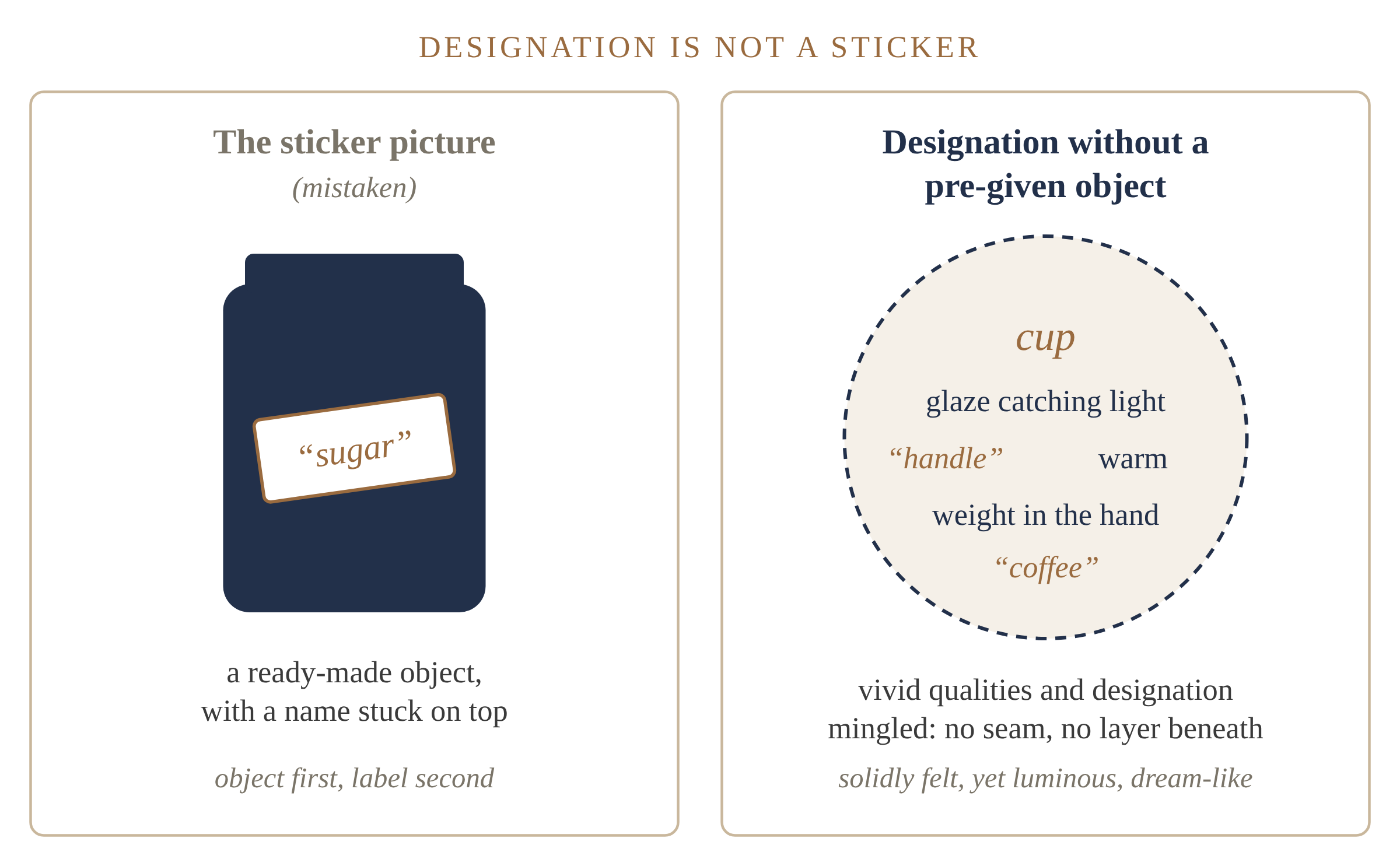
Figure 9. Designation is not a sticker. With no pre-given object, designation and vividness are mingled, with no seam and no layer beneath.
This intimacy explains something that would otherwise be puzzling: why designation, which is so pliable, feels so solid. We never catch ourselves designating. Because there is no gap in which the designating could be noticed, it is felt not as a way of taking the world but as the world itself. This is the innate grasping of Chapter 1 seen from the inside: not an extra belief added to perception, but designation taken for the thing designated—and so felt as undeniably real, inherent, there from its own side.
When this is seen through, nothing vivid is lost. The cup is still on the table, its glaze still catching the light; the coffee is still hot. What changes is the felt solidity. Appearance is met as luminous and dream-like—not faint, not unreal, but light, like the world of a lucid dream, in which everything remains vivid and works by its own logic while being known, all the while, as dream. The Diamond Sūtra gathers this taste into a single verse (ch. 32), likening all conditioned things to a star, a fault of vision, a lamp, an illusion, dew, a bubble, a dream, lightning and a cloud. Each image is vivid; none is findable; and none of them stops being what it is. This is the concordant experience of Mipham's second model in Chapter 5: the same appearances, no longer misread.
Dōgen gives the same point a sharper edge. An old Zen saying, traced to Xiangyan Zhixian, who burned his notes on the sutras when study failed him, warned that concepts cannot bring realization: a painted rice cake does not satisfy hunger. In the Shōbōgenzō fascicle Gabyō ('Painting of a Rice Cake') Dōgen turns the saying over. If a painting is not real, he argues, then nothing in the world is real either. 'There is no remedy for satisfying hunger other than painted rice cakes,' he writes. 'Without painted hunger you never become a true person' (trans. Tanahashi). The old saying assumed an unpainted cake behind the painted one—a real, undesignated rice cake, of which pictures and words are pale copies. Dōgen declines to look for it. Every rice cake anyone has eaten was met within a hunger, a harvest, a meal and a name: already painted. This is not the claim that rice cakes are only pictures; the painted cake feeds. Read in Madhyamaka terms, the painting is designation, the hunger it satisfies is designated too, and neither is less real for that. A longer exercise built on Gabyō is given in The Transition from Anatta to Emptiness.
A Buddhist Myth of the Given
Sellars attacked the Given from inside Western empiricism. Buddhist philosophy had worked out its own version centuries earlier, with greater rigour, and it is the strongest form of the view this chapter resists.
Dignāga (c. 480–540) opens his Pramāṇasamuccaya with a symmetry. There are exactly two means of valid knowledge, perception and inference, because there are exactly two kinds of object (PS 1.2). The particular (svalakṣaṇa), what characterizes itself alone, is grasped by perception. The universal (sāmānyalakṣaṇa), a general character shared by many things, is grasped by inference and concept. Perception itself is defined as free from conceptual construction (kalpanāpoḍha, PS 1.3).
Dharmakīrti (c. 600–660) sharpened the scheme. Perception is free from construction and non-erroneous (Nyāyabindu 1.4). What makes the particular ultimately real is that it alone can do something: it is capable of causal efficacy (arthakriyā-samartha, Nyāyabindu 1.12–15). Universals do nothing. The fire that is merely thought of burns no one.
The result is a two-storey epistemology. On the lower floor are momentary, efficacious particulars, touched by perception before any concept arrives. On the upper floor are concepts, which never touch particulars at all. They construct general characters by exclusion (apoha)—'cow' as what is not non-cow—and they are useful precisely because, strictly, they misrepresent what they seem to present.
This position should not be caricatured. Dharmakīrti does not posit a bare substance waiting beneath qualities; he rejects the very split between substance and property. His claim is subtler: the real is what functions, and what functions is met by perception before designation. That is why it is the strongest form of the Given. It is a Given without a substrate, built by philosophers who had already accepted momentariness and dependent arising. If any account could keep an undesignated layer while honouring everything else this book has argued, it would be this one.
Candrakīrti's reply
Candrakīrti takes up Dignāga's scheme at the start of the Prasannapadā, commenting on the first chapter of the Mūlamadhyamakakārikā. Three of his moves bear directly on this chapter.
The first concerns the word 'own-characteristic' itself. A characteristic (lakṣaṇa) is the characteristic of something (lakṣya): hardness characterizes earth. Is the characteristic different from what it characterizes? Then earth, apart from its hardness, has no characteristic, and nothing has been picked out. Is it the same? Then nothing characterizes anything, and 'own-characteristic' says nothing. This is the analysis Nāgārjuna applied to space (MMK 5; Interlude): characteristic and characterized are designated together, and neither is found first. A particular that is singled out as 'this, characterized by itself alone' has already been singled out by contrast—the very operation the two-storey scheme reserved for the upper floor.
The second move concerns what perception is of. Candrakīrti does not abolish perception. He accepts it as a means of knowledge, together with inference, testimony and analogy, exactly as the world uses them. But what the world perceives is the pot, not a momentary patch of colour. Pots and cloth are called pratyakṣa, evident, because they are not hidden; the cognition is named perception after them. The object of perception is already a designated whole, met as a pot from the start—the cup on the table in the previous section, seen as a cup.
The third move comes from Nāgārjuna. Means of knowledge and objects of knowledge, he argues, are not established by themselves; each is established only in relation to the other (Vigrahavyāvartanī 40–51). Dignāga's founding symmetry—two means because two objects—is therefore not a foundation. It is co-definition, like long and short.
Tsongkhapa makes the conclusion explicit and makes it a defining mark of Prāsaṅgika. Nothing is established by its own characteristic (rang gi mtshan nyid kyis grub pa), not even conventionally (Great Treatise, vol. 3; Cozort 1998). Other Buddhist schools refuted the particular's ultimate status and kept it conventionally. Prāsaṅgika refuses it at every level.
What is kept, and what goes
The refusal is narrow. Valid cognition is kept. Perception is still distinguished from inference, the snake in the rope is still corrected by the lamp, and Tsongkhapa's three criteria (section 13.6) still sort sound conventions from mistaken ones. What goes is only the claim that perception's object is there from its own side, before designation, as the floor beneath it.
Dharmakīrti's deepest reason for that floor was efficacy. Chapter 14 answers it. The key's power to open is found only with the lock, the hand and the door; causal efficacy is itself a relation. The mark the Pramāṇavāda took for the stamp of independent reality turns out to be the clearest mark of dependence. The Transition from Anatta to Emptiness works through the same exchange more informally, in the fourth and fifth rounds of its Beginner's Companion.
When the particular is not found, the two-storey building has no ground floor. Perception is not a lower layer, and conception is not a top coat. Vividness and designation, as the previous section put it, are mingled through and through.
Scale of Observation
Because no boundary is found from its own side, where a perimeter is drawn varies with the scale of observation and the purpose in hand. On a building site, a steel beam is solid and unyielding, a surface that will carry many tonnes. At the scale of atoms, the same beam is mostly empty space, held in shape by electromagnetic forces, with no hard surface anywhere. At the scale of an ecosystem, an animal is not a sealed body but an open exchange of gases, nutrients, energy and microbes with its habitat.
Each scale highlights a different functional perspective, and none of them—including a 'seamless field of interdependence' imagined beneath all scales—is the true layer. Designation is what lets us move between these scales without granting absolute, intrinsic solidity to any one of them.
Valid Designation: Criteria and Function
If conventions are not arbitrary, what distinguishes a valid designation from a mistaken one? Tsongkhapa gives three criteria (The Great Treatise on the Stages of the Path to Enlightenment, vol. 3, 178). A thing exists conventionally if it is known to a conventional consciousness; if what is so known is not contradicted by another valid conventional cognition; and if it is not contradicted by reasoning that analyses the ultimate.
The rope and the snake show how the criteria work. The snake in the rope is known to a conventional consciousness, but it is contradicted by another—the lamp, the second look, the touch—and so fails the second criterion. An inherently existing rope would fail the third: it is contradicted by ultimate analysis, which finds no rope from its own side. The rope as conventionally designated passes all three. It appears, it holds up under every further conventional test, and it makes no claim to inherent existence that analysis could refute.
The criteria are not a test applied from outside the world's ways of working. A sound designation is one that works: what is designated does what it is taken to do, and holds up under further experience within the framework in which it is made. A table holds the books and does not give way; the rope, once the lamp is brought, ties, pulls and secures. Function here is not a further ground beneath validity; it is designated together with what functions.
Objection: Does Designation Make Reality Depend on Language?
If things are designated, does reality depend on words—on the vocabulary of a culture? This is the worry behind many forms of social constructivism, and it can seem to follow from everything argued so far.
Designation is wider than language. An infant distinguishes faces before it has names for them; a dog picks out its owner from a crowd; a bird, in its own way, singles out the branch it lands on. Conceptual designation includes these pre-verbal acts of discrimination as well as the elaborate conventions of human speech. And designation is not free. It is constrained at every step by what holds up under further experience. Different cultures draw some boundaries differently—colour terms, kinship categories, the edges of a landscape—but no culture can walk across a shadow. Reality does not depend on language. It is not found apart from the designating, and the designating is not found apart from what it designates.
Objection: Is It Then Conceptual All the Way Down?
If there is no Given—neither Locke's substance nor the Pramāṇavāda particular—the opposite conclusion beckons. Perhaps experience is concept through and through, and the world is simply what our concepts make of it.
The most careful modern form of this thought is John McDowell's. In Mind and World (1994) he argued that conceptual capacities are already at work in perceptual experience itself, which is how experience can give us reasons. The conceptual, he wrote, is unbounded: there is no outer edge beyond which a non-conceptual given waits. Readers often summarize the view as 'conceptual all the way down'. Hubert Dreyfus objected that this cannot be right of skilled, absorbed activity. The chess master who sees the move, the expert who simply copes, is not applying concepts at all (APA presidential address, 2005). The exchange that followed, in Inquiry (2007), is one of the most instructive debates of recent philosophy.
The Madhyamaka sides with neither. McDowell is no idealist; he insists the world constrains what we think. But a mind whose concepts reach everywhere, read as an account of what reality is, has replaced the substance of the realist with the concept of the idealist. Chapter 7 met this move with idealism and panpsychism, and Chapter 12 with Mind-Only. Dreyfus's absorbed coping, read the same way, restores a pre-conceptual floor—the Given in practical rather than perceptual dress. Each makes one term prior.
What the analysis keeps is a symmetry, in two parts.
Appearance is not raw material for concepts. The ice stings with its own sharpness; no one decides the sting. A shadow cannot be designated a bridge (section 13.1). The constraint that keeps designation from being arbitrary is not a given layer beneath it: it is the reliability in use of appearances that are vivid and designated together (section 13.2).
Concepts are not a veil over appearance. The cup is seen as a cup (section 13.3), the duck as a duck (section 10.4). Designation is not a screen held in front of the world; it is in the appearing.
Neither is the ground of the other. Concepts draw their content and their correction from what appears, and what appears is picked out and made usable through designation. They are designated together, like long and short. Even the words 'conceptual' and 'non-conceptual' are co-defined: each is identified only as the other's contrast.
Dreyfus's own best examples show this. Riding a bicycle (section 11.9) is not a set of rules stored in the head, and it is not a wordless reflex beneath all rules either. The skill is designated together with rider, machine, slope and wind, and found in none of them alone. And designation, as section 13.7 argued, is wider than language. 'Conceptual all the way down' mistakes designation for a kind of sentence. 'Non-conceptual at bottom' mistakes the absence of words for the absence of designation.
The ordinary distinction survives. Seeing a snake is not remembering one, and a perception can correct a thought, as the lamp corrects the rope. Dharmakīrti's line between perception and conception keeps its conventional use. What it loses is the claim to mark two natures, one beneath the other.
So the answer to the objection is not 'conceptual all the way down', and not 'non-conceptual at the bottom'. There is no down.