The Logical Necessity of a Substrateless World
Introduction: The Unravelling of the Substantialist Premise
Watch a whirlpool in a river. It has a shape you could sketch, a place you could point to, a lifetime you could time with a watch. Children throw leaves into it to see them spin. Yet not one drop of the water that makes it up stays in it for more than a moment; every drop is arriving or leaving. Ask what the whirlpool is, apart from the water passing through it, and nothing can be found. Ask whether it is therefore unreal, and the leaves go on spinning.
Or hold a cube of ice. The cold is sharp and unmistakable, and it seems, beyond any doubt, to be in the ice. Yet look for the cold in the ice, in the hand or somewhere between them, and it is not there (Chapter 5). The coldness is vividly there, and it is nowhere to be found when sought.
This book is about that double fact—vivid presence and complete unfindability—and about what follows when it is taken all the way. Its claim is that the double fact is not a curiosity of whirlpools and ice cubes, but the condition of everything that can be posited at all: objects, persons, minds, moments, relations, and the very dependence through which they appear.
The Thesis in Brief
Nothing can be coherently posited as existing from its own side. Whatever appears is designated in dependence—and dependence, too, is designated. This demonstrates emptiness without asserting any ground, and it leaves the world of appearances standing, vivid and fully functional.
The Claim
For centuries, common sense and classical metaphysics have shared an intuitive assumption: that reality is made of things that exist from their own side—self-contained 'nouns' with their own natures, boundaries and powers, which enter into relations only afterwards. Philosophy has given this assumption many names: substance, essence, own-nature (svabhāva). This book argues that the assumption cannot be made coherent. Intrinsic nature is not merely absent from the world as a matter of fact; it is logically impossible for anything that appears in dependence—and nothing can be posited that does not.
The argument is not inductive. It does not survey the world and report that no essences have turned up. It shows, by consequence (prasaṅga), that any proposal of an independent thing undermines itself: to propose it is already to pick it out by contrast and designation, and so to make it dependent. The conclusion is a negation without a thesis—a non-implicative negation (prasajya-pratiṣedha) that refutes intrinsic nature without putting anything in its place. Throughout, dependent arising is used to demonstrate emptiness, never to assert a new ground. 'Logical necessity', in the title, means the necessity of such a consequence: not a proof, from premises every metaphysician must accept, of what holds in every possible world, but a demonstration that the opponent's own proposal cannot be stated without undermining itself (Chapter 2). Likewise, 'substrateless' names an absence, not a kind of world: the book describes no positive structure that reality has instead.
Yet the book is not an exercise in relentless negation. Appearances are left standing in full—vivid, reliable, able to feed, warn, bind and heal—and the formation of appearances is itself what shows their emptiness.
Why It Matters
Why should any of this matter outside a seminar? Because the habit this book examines is not idle. Whatever is taken to exist from its own side is grasped as if it could be possessed, defended or lost once and for all. The reputation that seems simply mine, the insult that seems to sit in the words themselves, the self that seems to stand behind every experience and to be threatened by its ending—each is felt as solid, and each is held with the tightness that solidity invites. Buddhist traditions have always located the root of suffering here: not in appearances, but in reading them as more than they are.
The same habit shapes inquiry. Debates about consciousness, causation and the foundations of physics often stall at the same place: each side assumes that something must be fundamental, and argues only about which. Matter or mind, particles or fields, objects or structures—the question 'what is the ground?' is rarely itself examined. A view that finds no ground anywhere, and shows why none is needed for anything to work, does not settle these debates by choosing a winner. It removes the assumption that made them seem unavoidable.
None of this is offered as consolation; the argument stands or falls as argument. But it is offered as something that can be checked in real time, by anyone, with whatever is at hand, and the checking changes how the thing in the hand is held.
Two Opponents
The first opponent is substantialism, in its theoretical and its everyday forms. Its theories—Aristotle's primary substance, Descartes' independent substance, the Abhidharma's constituents with their own natures—are examined in Part I. Its everyday form is more pervasive and more important: the innate, unlearned sense that the phone in one's hand or the coldness in the ice is simply there, finished, from its own side. That habit of perceiving, more than any theory, is the book's real subject.
The second opponent is subtler, because it looks like an ally. Once things are seen to depend on relations, it is tempting to make relation itself the new foundation: a network, a field or a structure out of which objects are made. Relational foundationalism of this kind appears in metaphysics, in the philosophy of physics and in popular presentations of Buddhism alike. This book rejects it as firmly as it rejects substance. Relation and relata are designated together, within the conceptual framework that distinguishes them; neither is prior, and neither is a ground. 'Relation is primary' is useful as a corrective to the habit of seeing self-standing things, and must be let go once it has done its work.
There is also an opposite misreading, less an opponent than a shadow cast by the argument itself. If nothing exists from its own side, perhaps nothing exists at all—or what remains is a vast emptiness behind appearances, a void into which they dissolve. Nāgārjuna warned that emptiness wrongly grasped destroys the one who grasps it, like a snake seized by the wrong end (MMK 24.11). Chapters 3 and 6 meet this misreading directly. To conclude that nothing works, or that nothing matters, is to keep the substantialist's standard of reality and simply find that nothing meets it.
Lineage and Conversation
The view defended here is that of Madhyamaka in its Prāsaṅgika form: Nāgārjuna's Mūlamadhyamakakārikā, read through Candrakīrti, and through Tsongkhapa's insistence that negation must hit its target—inherent existence—without sweeping away the conventional world. Mipham's two models of the two truths, and Dōgen's account of firewood and ash, help to show how the negation and the vividness belong together. These sources are introduced where they are used; the book does not assume familiarity with them.
Within that lineage, the view of this book is a rangtong reading of Nāgārjuna's Mūlamadhyamakakārikā: everything, mind included, is empty of its own nature, and that emptiness is a non-implicative negation, which removes what was never there and puts nothing in its place. On luminous clarity the book follows Nyingma Dzogchen, which takes the Mūlamadhyamakakārikā as its view. Luminosity is the knowing clarity of appearing itself, as empty as everything else (section 7.10). It is never an ultimate that is empty of other things but not of its own nature, as the shentong ("empty of other") reading holds.
The book also argues in the open air of contemporary thought. It engages philosophy of mind on the Hard Problem of consciousness; enactive and 4E cognitive science, which first drew on Nāgārjuna in The Embodied Mind; predictive processing; relational interpretations of quantum mechanics; and recent metaphysics of grounding, structure and powers. It is written for readers who come from either side: students of Buddhist philosophy who want to see the view tested against contemporary thought, and philosophers and scientists who want to see what a rigorously non-foundational position actually claims.
A Working Vocabulary
A few terms are used consistently throughout. Where the book speaks of co-definition or co-arising, it means only that the terms are designated together, neither prior to the other—not that some process brings them forth. Dependence is a thing's being identified only through what it is not—its parts, causes, contexts and contrasts, and the designation under which it is picked out. Designation (prajñapti) is the picking out of something as this rather than that, by perception, concept or language; it is constrained by what holds up under further experience, and is not arbitrary labelling. Unfindability is what results when a thing is sought apart from its dependencies and nothing is found; it is not non-existence.
Conventional truth is the world as it appears and functions; ultimate truth is its emptiness of inherent existence. They are two aspects of one appearance, not two levels of reality. Non-dimensional names exactly this: there is no deeper level beneath appearances—no backstage, substrate or ground—and no higher level above them. Emptiness (śūnyatā) is the absence of inherent existence. It is not a substance, not a void and not a view; it, too, is empty.
Inherent existence, own-nature (svabhāva) and existence from its own side name the same thing: what a thing would have if it were what it is independently of everything else, including the mind that picks it out. It is the object of negation throughout, and nothing else is negated. The basis of designation is what a designation is made upon—the parts of the chariot, the aggregates of the person—and it is designated too: there is no undesignated layer on which labels are placed.
How to Read This Book
Each chapter takes a candidate for what might stand on its own—a substance, a relation, a moment, a mind, a self, a power, a particle—and applies the same test: sought apart from what it depends on, is it found? The answer is the same each time, and the repetition is deliberate. What the argument establishes in general it has to establish again in each domain, because the habit it addresses does not give way in general; it retreats to wherever it has not yet been examined. Because the key words—dependent arising, condition, time, emptiness—are easily heard through the very habit under examination, the Interlude after Chapter 1 sets out how each is meant, and a Glossary at the end gathers them for reference.
A second pattern recurs in the chapters that engage contemporary thought. Each conversation begins with real convergence—Rovelli's relational quantum mechanics, Barad's agential realism, enactive cognitive science, Parfit's reductionism—and each locates the point at which something is quietly installed as the new ground. These are less refutations of those thinkers than an account of where the Middle Way takes one step further.
Finally, the argument is meant to be tested in experience as well as in thought. Many chapters include a lived example—holding a phone, touching ice, riding a bicycle, a rubber hand that comes to feel like one's own—that can be tried while reading. The analysis is not complete when it has been followed. It is complete when the thing in the hand is seen as vivid, functional and unfindable at once. The contemplative path behind this argument—how it came to be lived, from the realization of anatta to emptiness—is told separately in The Transition from Anatta to Emptiness.
Roadmap of the Volume
The argument unfolds in five Parts, each depending on the one before. The table summarizes the course of the argument:
|
Volume Part |
Core Themes & Philosophical Focus |
|---|---|
|
Part I |
The Fallacy of Substantialism & The Logic of Dependency: Establishes why intrinsic nature is logically impossible and how unfindability resolves classic metaphysical dilemmas. |
|
Part II |
Relation Without Ground, Co-Definition & Non-Dimensional Reality: Shows why entities and relations are designated together, neither prior, collapsing two-tiered ontologies and absolute voids. |
|
Part III |
Reframing Consciousness, Mind & Experience: Dissolves the Hard Problem of Consciousness through subject-object co-arising, reframing deep sleep, state transitions, and continuity. |
|
Part IV |
Perception, Cognition & 4E Theories: Brings the analysis into conversation with Embodied, Embedded, Enacted, and Extended cognitive science, collapsing the Cartesian split. |
|
Part V |
Boundaries, Designation & Scientific Methodology: Shows how designation is constrained, how function needs no intrinsic power, and how science can be read as modelling designated regularities, down to the quantum level, without needing a substrate. |
The book ends where it begins, with appearances in hand—and with what is, and is not, taken away by the analysis.
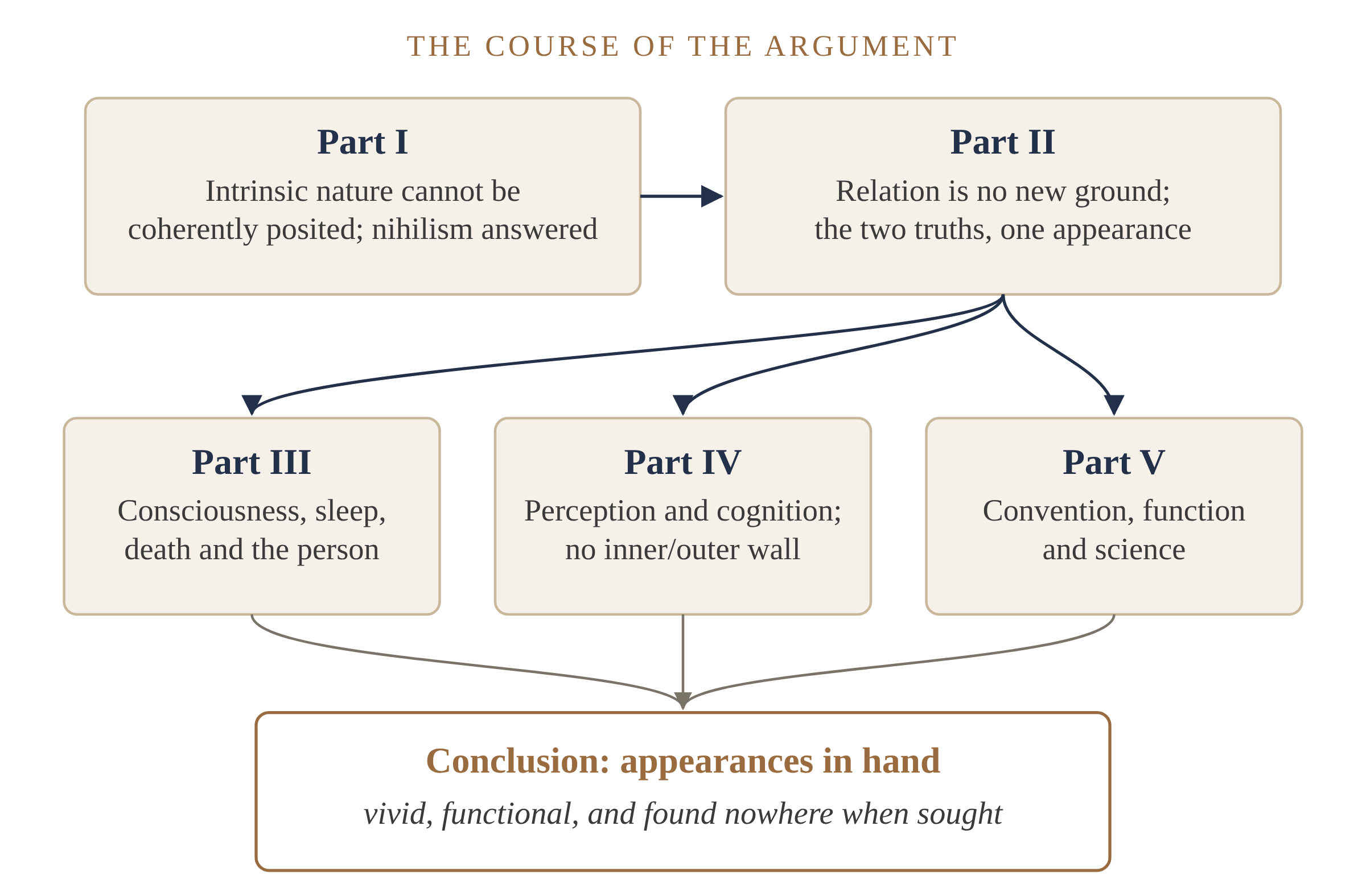
Figure 1. The course of the argument. Parts I and II make the case; Parts III–V apply it where the sense of self-standing things is strongest.