The Logical Necessity of a Substrateless World · Chapter 3 · Part I
Unfindability and Freedom from the Eight Extremes
Dependency and Unfindability: The Rainbow Principle
If a phenomenon is dependently arisen, it cannot be identified or established in and of itself. When its dependencies are systematically examined, no independently existing core remains—a result known as unfindability.
Crucially, unfindability does not mean non-existence or that nothing appears. Rather, it means that what appears cannot be isolated as a self-existing essence. A rainbow shows this vividly.
It appears plainly. It can be photographed, pointed to, and predicted from the angle of the sun, the moisture in the air and where one stands; walk on, and it moves with you. Yet if the rainbow itself is sought as an object existing apart from light, rain and the eye, nothing is found.
Ordinary phenomena—such as a table, an organism, or a mind—differ only in that we are more accustomed to treating them as solid, standalone entities. This yields one of the central insights of dependent arising: vivid appearance does not imply ontological solidity.
The Chariot: Candrakīrti's Sevenfold Analysis
The rainbow shows unfindability in an object we already suspect of being insubstantial. Candrakīrti chose instead an object no one doubts: a chariot (Madhyamakāvatāra 6.151 ff., developing an example from the early Buddhist texts). If the chariot exists by its own nature, it must be findable in some relation to its parts. He considers seven possibilities.
The chariot is not identical with its parts, for there are many parts and one chariot. Nor is it different from them, for no chariot is found apart from the wheels, axle and frame. It does not possess the parts as their owner, as if it stood beside them; nor is it in the parts, nor are the parts in it, as if one were a container for the other. It is not the mere collection of the parts, for a heap of parts is not a chariot. And it is not their shape, for the shape is either the shape of the individual parts, which were already examined, or of their arrangement, which is itself designated. Sought in each of these seven ways, the chariot is not found.
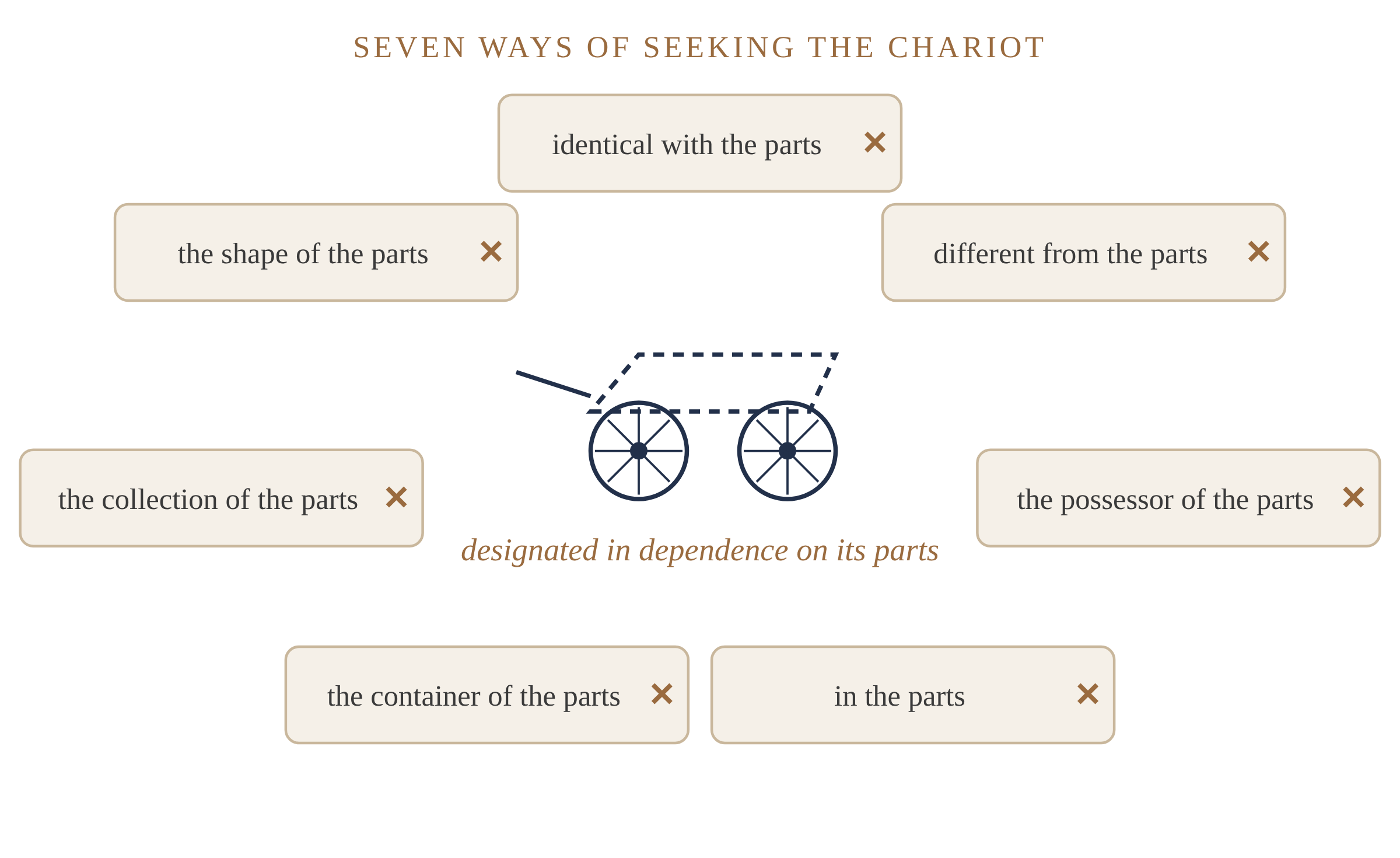
Figure 2. The chariot sought in seven ways (Madhyamakāvatāra 6.151 ff.). It is found in none of them, yet, designated in dependence on its parts, it still carries passengers.
Yet no one is stopped from riding it. The chariot is designated in dependence on its parts, and as so designated it carries passengers, breaks down and is repaired. The analysis removes nothing that worldly convention relies on; it removes only the assumption that the chariot is there from its own side, waiting to be found.
The Eight Extremes
Nāgārjuna opens the Mūlamadhyamakakārikā not with an argument but with an act of homage. He bows to the Buddha, best of teachers, who taught dependent arising as without ceasing and without arising, without annihilation and without permanence, neither one thing nor many, without coming and without going: the quieting of elaborations, peace. These are the eight extremes, in four pairs, and the verse does something easily missed. It does not set dependent arising on one side and the eight negations on the other, as if what arises dependently were then also, somehow, free of arising. The negations describe dependent arising itself. What arises in dependence is exactly what is not found to arise, cease, endure, perish, come, go, or be one with or other than anything else. Each negation is non-implicative: 'without arising' does not point to something that stays unborn, any more than 'without going' points to something that stays put.
This is where the mind refuses to follow. Dependent arising sounds like a description of arising—things coming into being because of other things—and the homage seems to take back with one hand what it gives with the other. Either things arise, dependently, or they do not arise at all. What the mind cannot do, at first, is see that the two descriptions point at one appearance: that a thing's arising in dependence is the very reason no arising can be found when it is sought. If the sprout could be found arising, from the seed or from anything else, it would have an arising of its own, and it would not need to depend. The dependence is the unfindability, seen from the side of convention.
The Sanskrit word for 'extreme' is anta, an end or edge: the far edge of a field, a place where one could stand. Each extreme is a place for a thing to be. Arising puts the thing at a starting point, ceasing at an end point; permanence keeps it in place through time, and annihilation removes it to nowhere; coming and going move it from one location to another; identity and difference set it beside something else to be compared. All eight ask the same kind of question: where is it? Where did it come from, where has it gone, is it still there, is it this or that? And all eight presuppose something with whereabouts—something that can be located, in time, in space or in identity, from its own side. That is the single assumption behind them. When it goes, the eight do not have to be refuted one by one; they lose what they were about.
This is not only a conclusion of argument. It can be checked in the most ordinary moment, in perception and in conception alike. Hear a car pass in the street. The sound swells, is present and fades. Where was it before you heard it? Where is it now? Not in the car, which makes no sound when parked; not in the air, which carries nothing on its own; not in the ear, which is silent without it. Or notice a thought—about lunch, about a friend—as it appears and gives way to the next. Where did it come from, where did it stay, where did it go? The questions are not hard because thoughts are too quick to follow. They cannot be answered because nothing there has the kind of whereabouts they ask for. And yet the sound was heard and the thought was thought, vividly and with effects: you looked up at the window; you decided to eat.
Present Without Being Produced
When conditions come together, appearances are simply present. Strike a match: there is a flame. Nothing seems more obvious than that the flame was produced—that it was not there, and then, because of the match, it was. Why should this not be called production?
Look at what production would require. There would have to be a flame first absent and then present, and an edge between the two: a moment at which the flame passed from not being to being. Look for the edge. Is it when the match head touches the strip, when the tip catches, when the first glow appears, when the matchstick itself begins to burn? Slow the film down as far as you like; at every frame something is going on, and at no frame is there a flame crossing over from nowhere. And ask what would cross. If the flame already existed before the crossing, it would not need to be produced; if it did not exist, there would be nothing to do the crossing, and nothing for the match to act upon. A condition, Nāgārjuna says, fits neither a thing that exists nor one that does not (MMK 1.6). Production in the strong sense needs a thing on both sides of an edge, and neither the thing nor the edge is found.
Nor do the conditions line up in advance, waiting to produce. 'Conditions align' is itself a way of speaking. A match is the condition of a flame only because a flame arises in dependence on it (MMK 1.5; Interlude); unstruck in its box, it is not yet the cause of anything. Match, striking, air and flame are designated together, as the coldness is designated with the hand and the ice (Chapter 5). There is no backstage where the conditions assembled the flame and then pushed it out on to the stage. There is simply the flame, present, as they are present.
What, then, does the word 'produced' do? It does real work. 'She lit the fire at eight' is true. Within the framework of before and after, cause and effect, such statements track what reliably follows from what, and every craft and science rests on them. What the word does not do is report a production found from its own side: a self-standing effect issuing from a self-standing cause across an edge in time. Tsongkhapa draws the line exactly there. What reasoning negates is arising established by its own nature, not mere arising as the world speaks of it (Great Treatise, vol. 3). When the flame goes out, its ending is designated as the end of a burning, within the same framework, not as a collapse into a void. Production and cessation are kept, as designations that work. Only the producer and the annihilated thing are let go.
Non-Arising (Anutpāda)
The refutation of a producer must be taken one step further. After the homage, the first verse of the Mūlamadhyamakakārikā (1.1) rejects arising from self, from other, from both, and without cause. Replacing a producer-entity with 'conditions' would only exchange one producer for many and leave arising from other in place, for conditions too are unfindable when sought apart from what they condition.
The orderly sequence of cause and effect is valid conventionally. Under ultimate analysis, nothing is found to arise at all. This is non-arising (anutpāda): not a denial of causal regularity, but the recognition that causal regularity, like everything it describes, is empty. Dependent arising does not establish a mechanism beneath appearances; it shows that no mechanism is there to be found.
The same analysis applies to abiding. Nāgārjuna examines arising, abiding and ceasing together (MMK 7) and finds that none of them can be established on its own terms: neither what has abided nor what has not abided can be found to abide, and the same holds for arising and for ceasing. It follows that appearances are not ultimately 'ongoing' while production and cessation are merely labels laid over them. Going-on is a form of abiding, and it is as conventional as coming and going. Where the Dzogchen tradition speaks of appearance as unceasing (ma 'gags pa), the word means unobstructed, not enduring: the display is unborn and unimpeded at once, emptiness and appearance not two. It does not name a stream that lasts.
Does this moment arise or cease?
A single question makes the point vivid. This moment, it is often said, ceases as it arises. Then does it arise, or does it cease? Put the question to the substantialist mind and watch it stall. If the moment arises, it has not yet ceased, so it does not cease as it arises. If it ceases, it must already have arisen, so arising and ceasing are not simultaneous. If it does both at once, one thing bears two contradictory properties in the same instant. If it does them in turn, a moment within the moment is needed for each, and the regress begins. Every answer fails, and the mind is left immobilized, unable either to answer the question or to set it down.
Nāgārjuna names this bind exactly: dissolution is not found without arising or together with it, and arising is not found without dissolution or together with it (MMK 21.1). The mind stalls because it has kept the one assumption that made the question seem answerable: that there is a 'this moment' standing there to do the arising and the ceasing. Drop that assumption and the question changes its character. Arising is identified only in contrast with ceasing, and ceasing only in contrast with arising; both are identified only within a framework of before and after; and 'the moment' is designated together with them, not found as a bearer to which they belong. Sought apart from one another and from that framework, nothing is found that arises and nothing that ceases. Nāgārjuna closes his examination of arising, abiding and ceasing by likening all three to a dream, an illusion, a city of gandharvas (MMK 7.34).
What remains is not stillness, and not a blank. The bell still rings; the sound is vivid and then gone; one can say correctly that it began at noon and faded a few seconds later. Conventionally, arising and ceasing are designated and reliable. What falls away is only the demand to know what the sound really did, from its own side—and with it the paralysis. The question is not answered; it is released. This is non-arising as it is actually tasted: not the denial of change, but change met without a thing that changes. Dōgen's firewood and ash, in Chapter 5, show the same from the side of time: before and after are cut off, so there is no single moment stretched between arising and ceasing that would have to do both.
No Whereabouts: Neither Coming Nor Going
The wanderer Vacchagotta once pressed the Buddha on what becomes of an awakened person after death. The Buddha answered with a question about fire. If a fire were burning in front of you, would you know it? Yes. And if it went out, would you know that it had gone out? Yes. Then in which direction has it gone—east, west, north or south? 'That does not apply,' Vacchagotta replies. The fire burned in dependence on its fuel of grass and wood; when the fuel was used up and no more was added, it is simply reckoned as 'out' (Majjhima Nikāya 72).
Why does the question not apply? Not because the fire went somewhere too far to see, or somewhere without direction—a hidden dimension where extinguished fires gather. And not because it went into nothing, as if 'nothing' were the one place left. The question does not apply because it asks for the whereabouts of a fire existing apart from its burning, something that could leave the hearth and carry on elsewhere. No such fire was ever there. Fire is designated in dependence on this fuel burning, and fuel as fuel only as being burned (MMK 10; Interlude). When the burning ends, nothing is left over for the directions to apply to. North, south, up and down are distinctions within space, and space itself is designated together with what is placed in it (Interlude).
The extinguished fire is not a special case. It shows what was true of the burning fire all along. While it burned, it was on the hearth, conventionally and reliably; one could warm one's hands at it and point to it. But sought as a fire apart from the burning of this wood, it was not found in the wood, nor apart from the wood, nor in the heat or the light. Where did it come from when it was lit? From the match? The match did not lose a flame. From the wood? The wood held no fire. The question of where it came from fails for exactly the same reason as the question of where it went. Coming and going need something that can be somewhere before and somewhere after, and the fire, though vivid, was never that kind of thing.
The Lalitavistara gives the same teaching through music. In dependence on the wood of the lute, its strings and the effort of the hand, a sound arises; yet one who searches for where the sound came from and where it went, searching in every direction, finds neither its coming nor its going (Lalitavistara Sūtra, ch. 13). The music is not less for that. It is heard, it moves people, and it ends when the player lifts her hand. It came from nowhere and went nowhere, and it was never anywhere other than in the playing.
The Mahāmudrā traditions turn this into a practice. The meditator is told to look, at the next thought that appears, for where it comes from, where it stays and where it goes (Wangchuk Dorje, Mahāmudrā: The Ocean of Definitive Meaning). The looking is not a search that fails for want of skill. Its finding is the not-finding: the thought appears vividly and does its work, and no place is found from which it came, in which it stayed or to which it went.
A lived example: switching off the lamp
Switch off the lamp. Where did the light go? Not back into the bulb, which is only cooling glass; not into the corners of the room, which are now dark; not out into the night. The light did not go anywhere, and yet a moment ago the room was full of it and you could read by it. Switch it on again, and ask where the new light came from. From the wires? The wires carry no light. From the power station? Nothing luminous travelled down the cable. The light is simply present when lamp, current and room are, and absent when they are not—'present' and 'absent' themselves designated within the framework of the room and the reader. That 'where?' cannot be answered is not a gap in our knowledge of light. It is the shape of every appearance, met directly.
Neither Permanent Nor Annihilated
The Śālistamba Sūtra, one of the earliest Mahāyāna texts on dependent arising, considers a rice seed and its sprout. Their relation, it says, is not permanence, because the sprout is not the seed; and it is not annihilation, because the sprout does not arise from a seed that has already ceased, nor from one that has not ceased—as the seed ceases the sprout arises, like the two ends of a balance beam, one falling as the other rises. Nor does anything pass over from the seed into the sprout (Śālistamba Sūtra).
Permanence and annihilation are the extremes of whereabouts in time. Permanence says the thing is still there, beneath the change; annihilation says it was there and is now nowhere. Both need a thing that was located, so that one can ask whether it remains. Nāgārjuna says that to hold 'it exists' of a thing standing on its own is to hold permanence, and to hold 'it does not exist' of what once so stood is to hold annihilation (MMK 15.10–11; Interlude). The seed and sprout show a middle that is not a midpoint: the sequence is conventionally designated as continuous in a recognizable way—rice yields rice, not barley—while nothing is carried through.
Neither the Same Nor Different
The last pair sets a thing beside another, to be compared. The chariot earlier in this chapter was neither identical with its parts nor different from them; the seed and sprout are neither one thing nor two separate things; and whatever arises in dependence on something, Nāgārjuna says, is neither identical with it nor different from it (MMK 18.10). Chapter 4 takes this pair up in full. Here it is enough to see that it has the same shape as the others. Sameness and difference are the whereabouts of a thing among other things, and they too need a thing that is somewhere, with an edge of its own, to be compared.
Freedom from the Extremes
The middle way does not select a middle position between opposing metaphysical extremes. Instead, it shows that the extremes themselves depend upon a substantialist framework that was never established to begin with. When the common substantialist premise disappears, all eight metaphysical extremes fall away simultaneously, leaving appearances vivid and dependently designated, with nothing found to arise, abide or cease.
This is the freedom the chapter's title names, and it is not remote. Appearances are simply present—the flame, the music, the thought, the light on the page—vivid, working, reliably named. They are not produced from anywhere, and when they end they go nowhere. Nothing in experience is lost by this, because nothing in experience ever had whereabouts of the kind the extremes required. Nāgārjuna's homage calls dependent arising, so seen, the quieting of elaborations (prapañcopaśama) and peace. The quiet is not a silence laid over the world. It is the world no longer asked to say where it is, and found, without that demand, to be fully present.
Objection: Is This Nihilism?
The most common objection to everything argued so far is that it amounts to nihilism. If nothing is found under analysis—not the chariot, not the self, not even dependence—then surely nothing exists. Nāgārjuna's own opponents raised exactly this objection: if all is empty, there is no arising and ceasing, and the Four Noble Truths, the path and its fruit are all undermined (MMK 24.1–6).
Nāgārjuna's reply turns the objection around. It is not emptiness but its denial that would make change impossible. If things had their own nature, they could not arise from causes, could not change, and could not be brought to an end; the path would be useless, since nothing could become other than it is. For whom emptiness is possible, everything is possible (MMK 24.14). The objector, he says, has projected his own faults onto the Madhyamaka, like a rider who forgets the very horse he is sitting on (MMK 24.15).
Nihilism and substantialism are the same mistake made from two sides. Both assume that to exist is to exist from one's own side. The substantialist concludes that things therefore have essences; the nihilist, that lacking essences they do not exist at all. Remove the shared assumption and neither conclusion follows. What remains is not nothing, and not a hidden something, but the conventional world exactly as it is used—designated, reliable, and ultimately unfindable.