The Logical Necessity of a Substrateless World · Chapter 4 · Part II
Mutual Dependency and the Non-Hierarchy of Relation
Part II Overview: Part II explores the mutual co-definition of entities and relations, collapses two-tiered ontologies into a non-dimensional reality of the two truths, and demonstrates the logical impossibility of absolute nothingness. Reality is understood not as a stacked hierarchy of substrates or an empty void, nor as a single-level relational field put in their place: relation, too, is a conventional designation, appearing only within the framework that distinguishes its relata.
|
Chapter |
Core Focus |
Key Philosophical Insight |
|---|---|---|
|
Chapter 4: Mutual Dependency |
Co-definition of entities and relations |
Relation is not a new substrate; 'relation is primary' serves as a tactical corrective against substantialism. |
|
Chapter 5: The Two Truths |
Non-dimensional two truths |
Conventional truth (vivid efficacy) and ultimate truth (unfindability) are two aspects of one appearance, not two levels. |
|
Chapter 6: Impossibility of Nothingness |
Absence as relative reconfiguration |
Absolute void is substantialism in reverse; absence is always relative, a designated reconfiguration rather than a drop into non-being. |
Avoiding the Substrate Trap: Relation Is Not a New Foundation
In moving away from substantialism, a common philosophical misstep is to replace 'entities' with 'relation' as a new, fundamental substrate or ultimate building block.
However, positing 'Relation' as a self-existing foundational layer reinstates the exact two-level ontology that dependent arising dismantles. If relation were treated as an independent, backstage engine that produces derivative entities, relation itself would be assigned an intrinsic nature—falling right back into the substantialist trap.
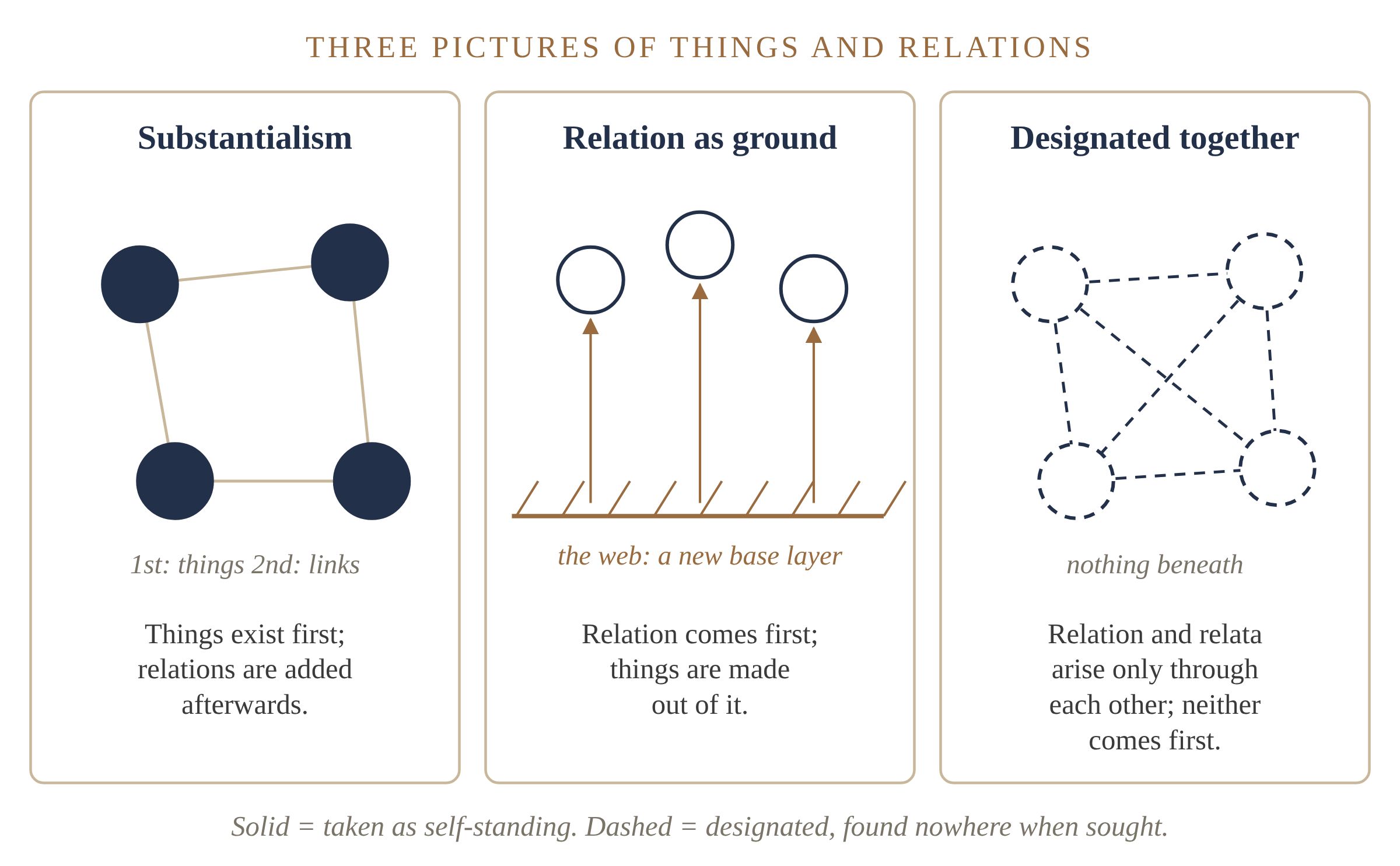
Figure 3. Three pictures of things and relations. The first two each make something prior; the third, the view of this book, makes nothing prior and puts nothing beneath.
The Simultaneous Co-Definition of Entities and Relations
Instead of positing a new metaphysical hierarchy, the analysis finds entities and relations designated together, neither prior to the other. An entity cannot be identified apart from its parts, causes, context, contrast and conceptual designation; and a relation is not a free-floating abstraction, apart from the relata it is said to relate.
Neither entities nor relations sit at the bottom of reality as a primary substance. Causation does not consist of a separate 'producer' generating a separate 'product'; nor do 'conditions' take the producer's place, since they are as unfindable as what they condition. Phenomena are designated in dependence on conditions, where parts and wholes, causes and effects, and entities and relations arise together in mutual dependence.
Co-Definition in Ordinary Experience
Co-definition is not an exotic doctrine. It is how the most ordinary distinctions already work. Nothing is long except in contrast with something shorter, and nothing is short except against something longer. A pencil is long beside a matchstick and short beside a broom; it has no length of its own apart from such comparisons. Long and short are not two properties that first exist and then enter into comparison. Each is identified only as the counterpart of the other.
The same is true of roles that seem far more solid. No one is a parent before there is a child, and no one is a child except in relation to a parent; the two are designated at once, in the same event. Buyer and seller, speaker and listener, host and guest—each pair arises together, and neither member can be found in advance of the other.
In none of these cases is there a third thing, 'the relation', standing between the terms and holding them together. Parenthood is not a substance linking parent and child; it is designated in exactly the same act that designates them. Relation and relata are co-defined, and so neither is the ground of the other.
Contemporary philosophy of science has arrived at a strikingly similar formulation. Karen Barad's agential realism, developed from Niels Bohr's account of measurement, holds that 'relata do not preexist relations': the determinate identities of things emerge only within what she calls intra-actions, as distinct from interactions between entities already separate (Meeting the Universe Halfway, 2007, 140). The word is well chosen. Inter-action presupposes two things that then act on each other; intra-action denies that the terms were there first. This is co-definition stated in the language of physics. Chapter 15 returns to Barad, and to the point at which her account and the present one part ways.
Objection: Is Mutual Dependence Circular?
An objector may protest that co-definition is viciously circular. If A is identified only through B, and B only through A, then neither is ever identified at all; the circle has no point of entry. Something, surely, must come first.
Nāgārjuna considers exactly this structure in his analysis of fire and fuel. If fire depends on fuel and fuel depends on fire, he asks, which of them is established first, so that the other may depend on it (MMK 10.8)? The question is not a difficulty for his position; it is the point of it. Neither is established first, and therefore neither is established from its own side. The same reasoning governs agent and action (MMK 8.12; Chapter 11).
The circle is vicious only for someone who expects dependence to transmit existence from a starting point—the grounding picture already examined in Chapter 2. For that picture a circle is as fatal as an infinite regress, since in neither case does existence ever arrive. But co-definition is not offered as a mechanism of existence. It describes how things are identified, and identification is always mutual: we pick out the fire by its fuel and the fuel by its burning. The demand that something come first is the demand for an intrinsic nature. Co-definition shows that the demand cannot be met, and that conventional life proceeds perfectly well without it. Fires are lit, fuel is gathered, and no one waits for the question of priority to be settled.
'Relation Is Primary' as a Tactical Corrective
When we state that 'relation is primary', this assertion must be understood as a tactical corrective against substantialist habits rather than the assertion of an ultimate metaphysical ground.
Reversing the substantialist order—insisting that relation comes first—serves to dismantle the illusion of self-standing entities by showing that separation into isolated items is conceptual.
However, once the habit of reifying independent entities is overcome, the statement 'relation is primary' has performed its therapeutic function. When the substantialist premise disappears, the need to assert an ultimate relational substrate disappears with it.
Relation as a Conventional Designation
If relation is not an ultimate ground, what is its status? It is conventional, and it appears only within a conceptual framework. To speak of a relation, two relata must be distinguished; to distinguish them, they must already be set in contrast—that is, related. Relation and relata are therefore not found one before the other. They are designated together, by the same act of conceptual framing that picks out this as distinct from that.
Tsongkhapa distinguishes three increasingly subtle senses of dependence: the dependence of effects on their causes, the dependence of wholes on their parts, and the dependence of anything at all on the conceptual designation that identifies it. The third is decisive, and it applies to relation itself. Causal dependence and part–whole dependence are relations; as relations, they too are identified only within a framework that discriminates cause from effect and part from whole. Nāgārjuna compresses the point into a single verse: what is dependently arisen is emptiness, and that emptiness is itself a dependent designation—this is the middle way (MMK 24.18).
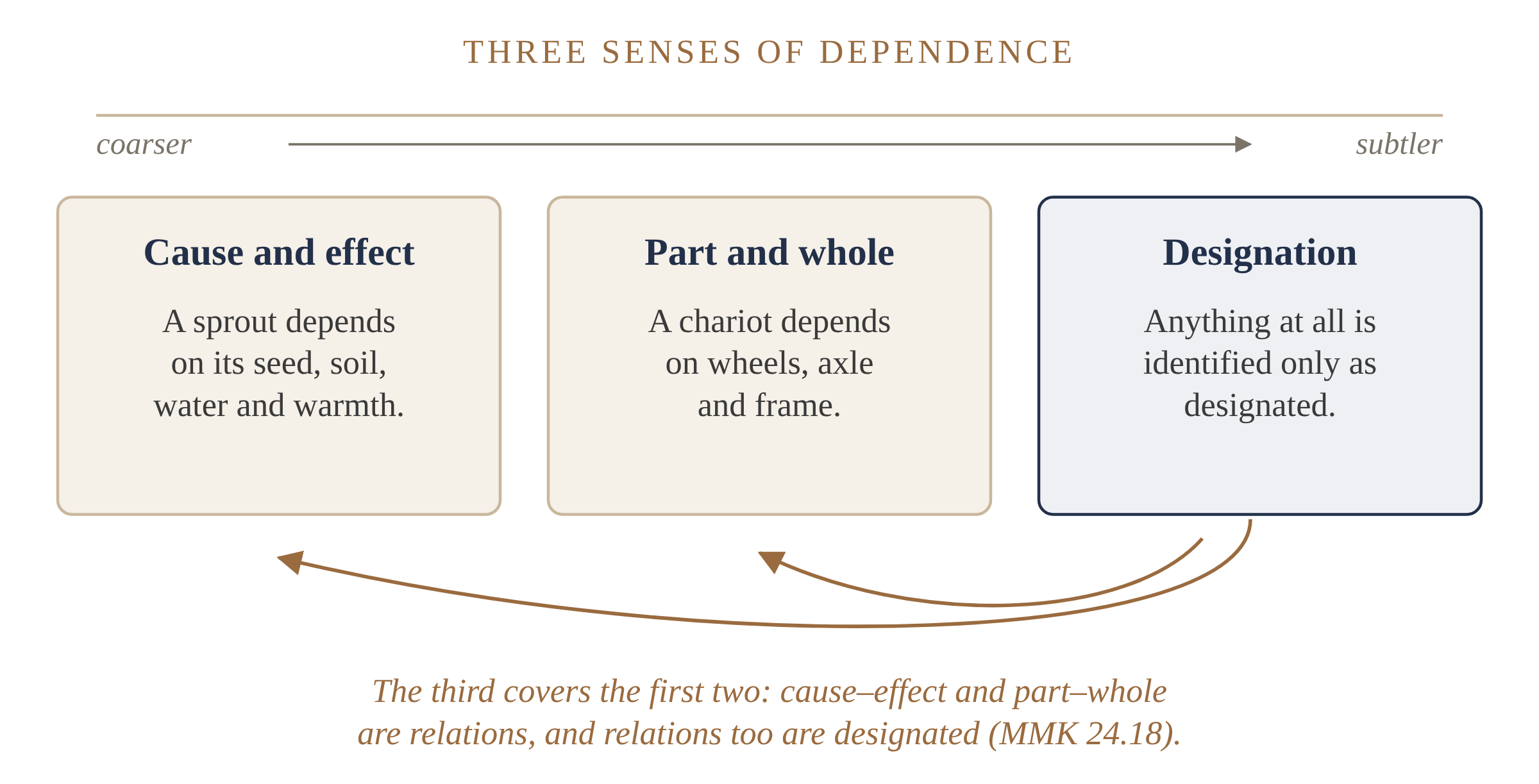
Figure 4. Tsongkhapa's three senses of dependence. They are increasingly subtle, not stacked levels: the third applies to the other two.
Relation is therefore conventional truth in the full sense. It is valid: within a framework, relations can be traced, measured and relied upon, and some descriptions of them are correct while others are mistaken. But it is not found under analysis. Sought apart from its relata and from the framework that discerns them, a relation leaves nothing behind.
This has a consequence for the language of the rest of this book. When later chapters speak of a 'relational event' or of 'co-arising', these are conventional descriptions offered from within a conceptual framework, as instruments for loosening the habit of reification. They do not report what reality is ultimately, and they are not a new substrate quietly put in place of the old one.
Beyond Hierarchical Ontologies
A genuinely substrateless worldview rejects all hierarchical ontologies, whether they take the form of physicalist reductionism (matter → interactions → mind) or relational foundationalism (relational network → emergent objects). Both models retain the mistaken assumption that reality consists of a fundamental 'lower level' generating a derivative 'upper level'.
Where no substrate is found, there is no backstage producer, no hidden depth, and no lower-tier reality doing work behind appearances. Phenomena appear vividly and function causally, conventionally, while remaining completely unfindable as independent essences under ultimate analysis. Reality is not a stacked hierarchy of substrates. Nor is it a single-level field that takes the substrate's place: 'field' is itself a designation, as unfindable as the entities it replaces.
No Inherent Boundary: Neither No Boundary Nor One Whole
Once it is seen that no boundary is found from its own side—not the edge of the ice, not the skin of the hand, not the line between a system and its environment—two conclusions suggest themselves at once, and both are mistaken. The first is that there are no boundaries at all: since the lines are not found, distinctions are illusions, and self and world, ice and hand, blur into an undifferentiated haze. The second, more seductive, is that everything is one: since nothing is separate, reality must be a single undivided whole, of which the apparent many are waves on one ocean.
The first is nihilism about distinctions. It discards the conventional world along with the inherent one, as if the failure to find a boundary from its own side meant that no boundary could be drawn. But boundaries are drawn constantly and reliably. The skin keeps the body's warmth in; the coastline is mapped; the wall of a house keeps out the rain. A boundary that is designated, not found, is still a boundary, and it does its work exactly as well as before.
The second is monism, and it is the more dangerous because it sounds like an insight. Priority monism in contemporary metaphysics holds that the cosmos as a whole is the one fundamental thing and that its parts are derivative (Schaffer, 'Monism: The Priority of the Whole', 2010); popular spirituality says that we are all one and that separation is the illusion. But a single whole that exists from its own side is a substance, however large—the many small substances of the substantialist exchanged for one great one. The whole is no more found apart from its parts than the parts apart from the whole; whole and parts are designated together, and neither is prior.
The third reading is the one this book defends. Boundaries lack inherent existence: they are not found from their own side. That is all. They are not thereby abolished, and the things they separate are not thereby merged. Figure 5 sets the three readings side by side.
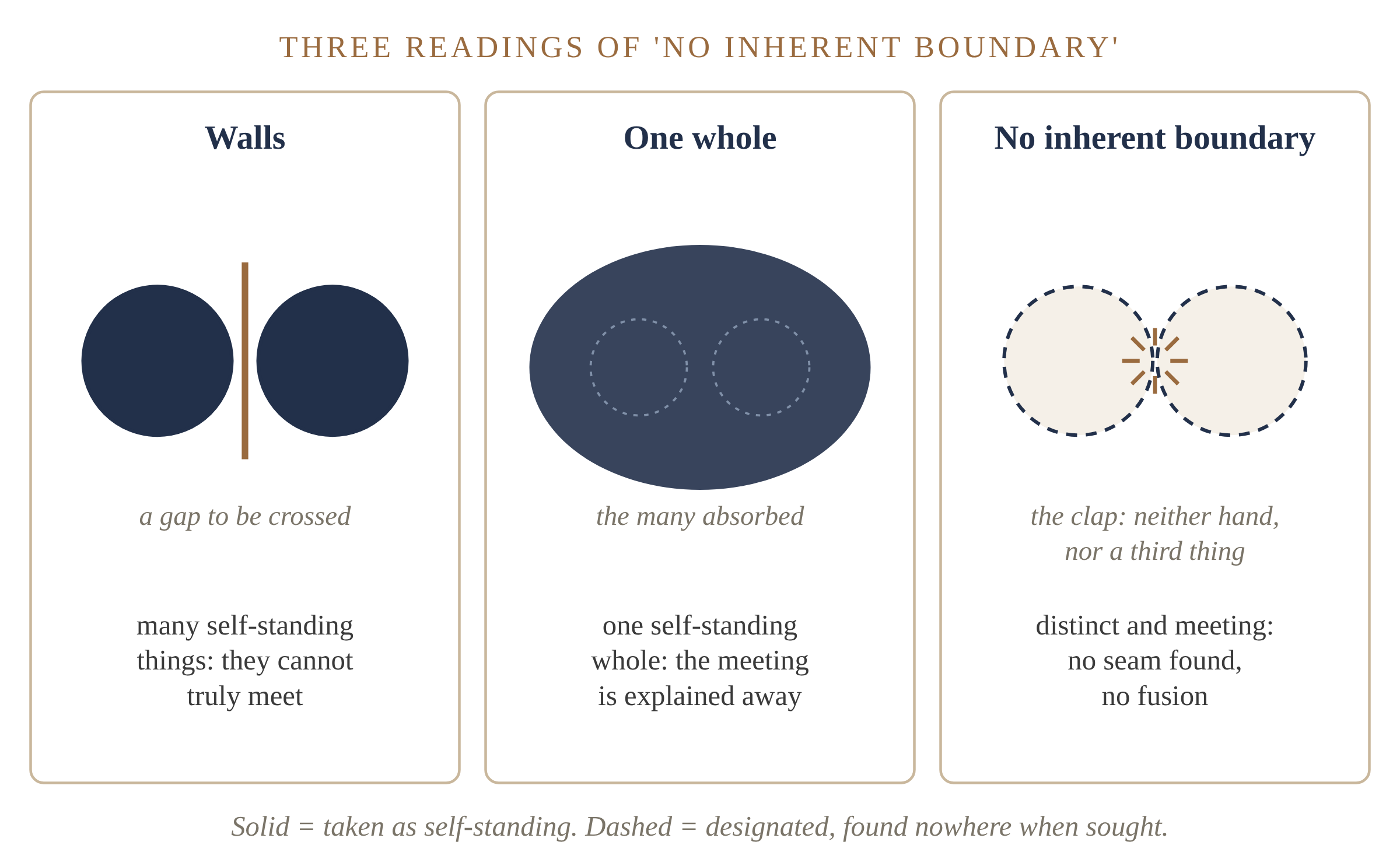
Figure 5. Three readings of 'no inherent boundary'. Walls make interaction impossible; one whole abolishes it; boundaries that are designated but not found let distinct things meet without a seam and without fusion.
The Problem of Interaction
The difference matters most where two things meet. Ordinary experience is full of interaction: the hand touches the ice, the voice reaches the ear, a decision moves the arm. Substantialism, which seems so well suited to common sense, has trouble here. Taken strictly—with substances complete in themselves—it has no account of how one reaches the other. Something would have to cross the gap between them. Whatever crossed would belong either to the first, in which case it never left, or to the second, in which case it was already there, or to neither, in which case it is a third thing facing the same problem twice.
Princess Elisabeth of Bohemia pressed a version of this point on Descartes in 1643. If the mind is an unextended thinking substance and the body an extended one, she asked, how can the mind move the body, when moving a body seems to require pushing, pushing requires contact, and contact requires extension (Elisabeth to Descartes, 6/16 May 1643, in Shapiro, ed., 2007)? Descartes's replies did not satisfy her, and many readers since have doubted that the question can be answered on his terms. Leibniz followed the logic to its end. A true substance, he concluded, has no windows through which anything could come in or go out (Monadology, §7); what looks like interaction between substances is a harmony arranged in advance, not real influence (§§78–81). Taken strictly, substantialism does not explain interaction. It makes real influence between substances impossible.
Monism fares no better. If the hand and the ice are really one thing, their meeting becomes one reality modulating itself—explained away rather than explained. Both extremes—many self-standing things and one self-standing whole—freeze the world in the way Nāgārjuna showed that own-nature would, leaving it unarisen, unceasing and static (MMK 24.16–20, 24.38).
How Things Meet: Neither One Nor Two
Nāgārjuna states the alternative in a single verse: whatever arises in dependence on something is neither identical with it nor different from it; therefore it is neither annihilated nor permanent (MMK 18.10). And the chapter on connection applies the point to meeting itself: a thing cannot combine with itself, and inherently different things cannot combine either (MMK 14.8; cf. 14.5–7, where difference itself is shown to be dependent).
This is the key to interaction. Meeting is possible only where neither has an edge of its own (compare MMK 24.14). Nothing crosses a gap, because no gap is found; and the two are not fused, because no single substance is found either. The coldness arises in dependence on hand and ice and is designated together with them (Chapter 5)—not inside the one, not inside the other, and not in a third thing between them. Interaction, where no substrate is found, is not a transaction between sealed units. It is dependent arising: hand, ice and cold arise together and are designated together, none found from its own side, and the cold is vividly felt.
A lived example: clapping
Clap your hands. Where is the sound? Not in the left hand, which makes no such sound on its own; not in the right hand either; and not in some third thing floating between them, waiting to be struck. Yet the sound is sharp and unmistakable, and the two hands remain two: you can still tell left from right, and one can sting while the other does not. The clap is neither the same as the hands nor different from them. It appears only as their meeting, and the meeting is found neither in the hands, the striking and the hearing nor apart from them.
Nothing in this requires the hands to merge into one hand, or the sound to be an illusion. Distinction and intimacy are present together, without a wall between the hands and without a single substance beneath them.
Seamless Without Fusion
The word 'seamless' is often used for this, and it is apt if it is heard correctly. It means that no seam is found—no line, existing from its own side, at which one thing ends and another begins. It does not mean one continuous cloth. A seam that is not found has not been erased to leave a single fabric; there was never a fabric of the kind that seams divide. The skin is still the edge of the body, conventionally and reliably. It is simply not an edge that exists by itself.
What remains is the ordinary world, full of distinctions that work and meetings that happen: a friend's hand in yours, a voice across the room, the cold in the palm—intimate without merging, distinct without walls.
Objection: Isn't This Simply Holism?
Holism, in its many forms, holds that the whole is more than the sum of its parts, or prior to them, and that the parts are what they are only within it. Much of this is congenial; holists have long criticized the picture of self-contained atoms. But holism usually keeps a whole that determines its parts—an organism, a system, a cosmos with a nature of its own—and so reverses the direction of priority rather than removing it. The Madhyamaka removes it. The whole is designated in dependence on its parts, as the chariot is in dependence on its wheels and axle (Chapter 3), and the parts are identified as parts only in relation to the whole. Neither comes first, and neither is found on its own.
A Contemporary Echo: Relational Physics
The argument of this chapter finds a striking echo in contemporary physics. In Carlo Rovelli's relational interpretation of quantum mechanics, the properties of a physical system are not possessed absolutely but only relative to another system with which it interacts; there is no view from nowhere from which a system simply has its values. Rovelli has drawn the connection to Madhyamaka himself, discussing Nāgārjuna at length in Helgoland (2021) and the idea that nothing exists in itself, independently of everything else.
The convergence is real, but it carries the risk this chapter has been guarding against. If relational quantum mechanics is read as saying that the world is ultimately made of relations or interactions—a network in place of a collection of objects—then it becomes one more relational foundationalism, with the network as the new substrate. The reading offered here points the other way. The relational account is a conventional framework of extraordinary power, valid within its domain and correct where it predicts well; but the 'relations' it speaks of are identified within that framework, and are no more findable apart from it than the objects they replace. Physics can show that properties are relative. It takes a further step to see that relativity, too, is empty.