The Logical Necessity of a Substrateless World · Chapter 5 · Part II
The Non-Dimensional Two Truths
Collapsing the Two-Tiered Ontology
Metaphysical systems frequently fall into a two-tiered ontology—a structural model that divides reality into a 'surface level' of ordinary experience and a 'deeper level' of fundamental reality. In classical physicalism, the colours, textures and middle-sized objects of experience are treated as a byproduct of a hidden substrate of particles or fields. In emergent accounts of mind, consciousness is a secondary glow given off by a non-conscious physical engine.
Both approaches preserve a spatial metaphor of depth: an unseen 'backstage' doing the real work, and a front-stage 'cover' where appearances manifest. The analysis of this book leaves no room for this two-tiered picture. On this analysis, there is no hidden substrate, no backstage producer, and no deeper spatial dimension sitting underneath appearances. Appearance is not a cover over something more real; there is nothing behind it for it to cover.
Conventional Truth: Vividness and Functional Efficacy
Conventional truth (saṃvṛti-satya) refers to the world of dependent arising as it is experienced and navigated in practice.
Candrakīrti, commenting on Nāgārjuna's verse on the two truths (MMK 24.8), draws out three meanings of the Sanskrit saṃvṛti, usually translated 'conventional'. It means concealment, because ordinary perception conceals the way things are by presenting them as existing from their own side. It means mutual dependence, because what is conventional exists only in dependence on other things. And it means worldly convention—designation, signs and language—by which things are named and agreed upon (Prasannapadā on MMK 24.8). The three belong together. Conventional truth is valid as mutual dependence and as convention; it is mistaken only in the concealment, the innate habit of reification described in Chapter 1.
Crucially, conventional truth is not a falsehood, an illusion to be discarded, or a secondary 'fake' reality. A table, a rainbow, a financial system, or a conscious thought are all thoroughly real conventionally. They show regularities that can be predicted; they do things and have effects; they can be measured, spoken of and acted upon.
Conventional truth is valid because its designations hold up: what is relied on, works. Recognizing that an entity lacks an intrinsic core does not diminish its conventional function; phenomena that had such a core could not act, interact or change at all (MMK 24.14).
Ultimate Truth: Total Unfindability
Ultimate truth (paramārtha-satya) does not refer to a hidden physical particle, a mystical realm, or a transcendental substance beyond the world. Instead, ultimate truth is simply the total unfindability of an intrinsic nature when any conventional phenomenon is subjected to ultimate analytical scrutiny.
When we examine any phenomenon—whether a physical object, a mental state, or a law of nature—in search of an independent core that exists from its own side, no such core can be found. Thus, ultimate truth is a truth about conventional things: the fact that they are empty of independent, intrinsic existence.
Two Aspects of One Appearance
The two truths are often misunderstood as describing two separate worlds or two distinct layers of existence. On this analysis, however, they are two aspects of one appearance.
Conventional truth is that appearance as it vividly works: the cup that holds the coffee, the rainbow arching over the field. Ultimate truth is the unfindability of any intrinsic nature in that very cup and that very rainbow. It is not a second object alongside the first, nor a deeper layer beneath it; it is what the first is found to be when it is sought from its own side.
The very same appearance that is vividly functional conventionally is completely unfindable intrinsically. The two truths are not two facts that support each other: that phenomena arise dependently is exactly what shows them to be empty of intrinsic nature, and their emptiness is shown only in their arising dependently.
Appearance Demonstrates Emptiness: The Coldness of Ice
Prāsaṅgika analysis is often mistaken for relentless negation, as though its work were finished once every essence had been refuted. It is not. Its negation has a precise target—inherent existence—and it leaves appearances standing in full. More than that, the formation of appearances is itself what demonstrates their emptiness. Tsongkhapa puts it in a single line: appearance dispels the extreme of existence, and emptiness dispels the extreme of non-existence (Three Principal Aspects of the Path, v. 13). An ordinary sensation makes the point concrete.
Hold a cube of ice. The cold is immediate and unmistakable: a sharp, spreading sting in the palm, then an ache, then numbness. And it seems, beyond any doubt, to be in the ice. The ice is cold; the hand merely finds out. This is the innate sense of reality described in Chapter 1, at its most convincing.
The coldness is not in the ice
Look for the coldness where it seems to be, and it is not found there. Place one hand in hot water and the other in cold, then both in the same basin of lukewarm water: to one hand the water feels cold, to the other warm (Locke, Essay Concerning Human Understanding II.8.21). The same ice that stings a warm palm is barely noticed by a hand already numbed, and not at all through a thick glove. What physics describes in the ice is a temperature—a measure of molecular motion—not the felt sting. Nor is the coldness a sensation sealed inside the hand, for without the ice there is no such sting. And it does not hang somewhere between them, as a third thing called 'the relation': sought there, it is found no more than on either side. Like Candrakīrti's chariot, the coldness is not in the ice, not in the hand, not in their meeting, and not apart from them.
Co-defined, with nothing prior
What appears is not an ice-thing that first exists and then transmits coldness to a feeler who first exists and then receives it. The coldness, the ice as cold, the feeler as one who feels, and the felt as what is felt are identified together, mutually and simultaneously. Nor are they assembled out of a prior relation, as if relation came first and its terms afterwards. Relation and relata are designated together, as Chapter 4 argues—and here that abstract claim is something one can feel in one's own hand.
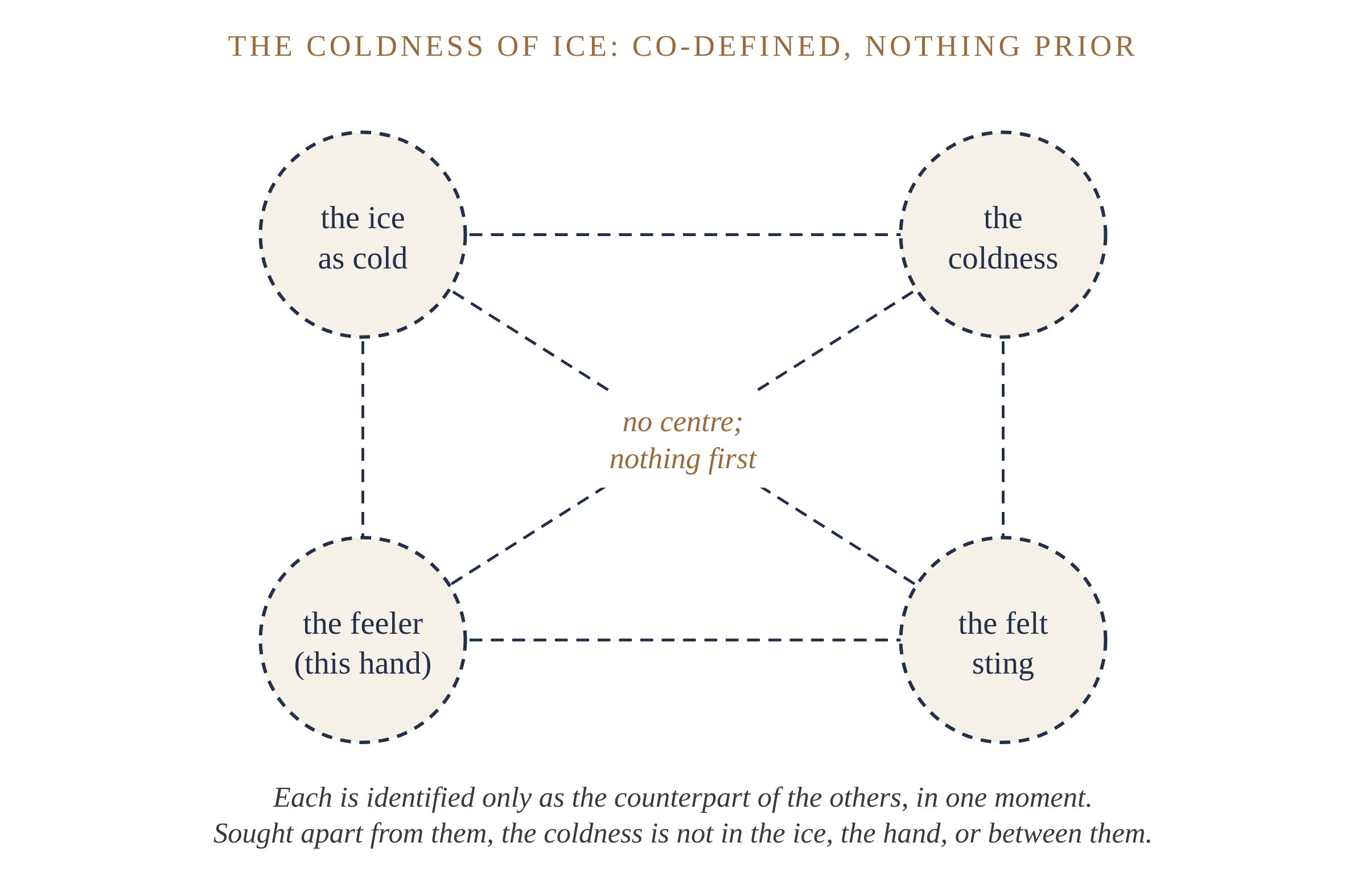
Figure 6. The coldness of ice. Ice, coldness, feeler and felt are identified together, each only as the counterpart of the others; no term is the centre and none comes first.
Dōgen gives the same insight its temporal form. Firewood becomes ash, he writes in the Genjōkōan, and cannot return to being firewood; yet we should not regard the ash as after and the firewood as before. Firewood abides in its own dharma position (jū hōi): it has a before and an after, but before and after are cut off. Life and death are likewise positions of time, like winter and spring—we do not think that winter becomes spring, nor say that spring becomes summer. Each appearance is fully itself in its own position, lacking nothing, with nothing carried across from one to the next. But the 'position' is not a self-standing atom of time, nor is time a container in which positions sit; for Dōgen being and time are not two (uji), and the positions, too, are designated, not found. What co-definition shows of the ice, the feeler and the felt within a single moment, Dōgen shows of firewood and ash across time: no prior thing, no later thing, no substance in between—and no ground of moments beneath them either.
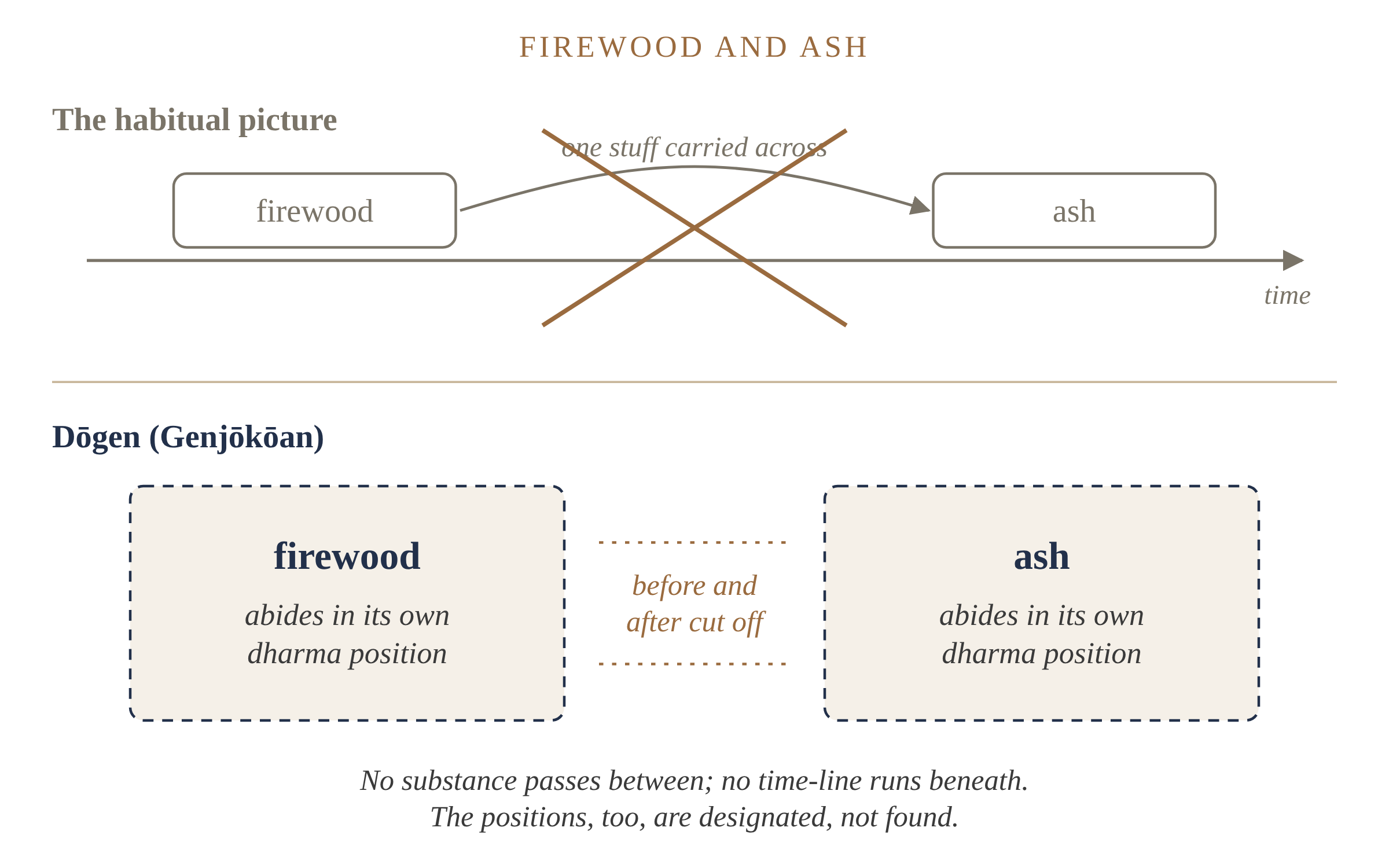
Figure 7. Firewood and ash. The habitual picture carries one substance along a time-line; Dōgen's dharma positions have before and after cut off, and are themselves designated, not found.
Formation as the demonstration
None of this makes the coldness less real. It forms—vividly and precisely, with its own sharpness and its own unfolding from sting to ache to numbness. It functions: it cools a drink, slows a swelling, warns the hand away. This formation is not a residue left over once emptiness has done its work; it is the very way emptiness is shown. Because the coldness forms only where ice, hand, warmth, nerve and attention come together, it cannot be something that exists from its own side. Its emptiness is no obstacle to its forming. On the contrary, an inherent coldness could never be felt at all—a claim counterintuitive enough to need spelling out.
Why an inherent coldness could not be felt
Ordinarily we assume the opposite. The more something is really, inherently there, we think, the more surely it can be felt; the vividness of the sting seems to be the very evidence that the cold is truly in the ice. Even students of Madhyamaka often treat inherent existence as an extra layer of solidity to be peeled away, leaving the feeling untouched underneath. The point here is stronger. Inherent existence is not merely unnecessary for feeling; it would make feeling impossible.
Consider what 'inherent' would mean. An inherently cold ice would be cold from its own side: its coldness fixed in it, owing nothing to anything else, the same whatever it met. But to be felt is precisely to owe something to something else. Felt coldness is cold to this hand, varying, as we saw, with the hand that meets it. It changes with what it meets, and it changes what it meets: it chills the skin, quickens the nerves, makes the hand pull back. Whatever can affect the hand, and be affected by the hand's warmth, already depends. A coldness that depended on nothing could make no difference to the hand and receive no difference from it. To be felt and to be independent are incompatible.
The same holds for the coldness's own unfolding. The sting gives way to an ache, the ache to numbness, and the ice itself melts. What exists by its own nature cannot become otherwise, for a change of nature would mean that its nature depended on conditions after all. Nāgārjuna draws exactly this conclusion: if things existed by their own nature, they would be without causes and conditions, and there could be no arising, no ceasing and no change (MMK 24.16–17; 15.8). The felt coldness, which arises, sharpens and fades, is therefore not merely compatible with emptiness; its arising, sharpening and fading are emptiness made evident. Empty, it is felt—sharply, and right now.
An analysis that refutes so much might be expected to leave a bleak world behind it: nothing in the ice, nothing in the hand, nothing between, nothing beneath. The taste of it, in real time, is surprisingly the opposite. What the analysis removes is not the coldness but the sense of a cold thing standing behind it, and of a feeler standing apart from it. With these gone, nothing is lost from the sting; it is, if anything, nearer and more vivid than before—met without a barrier, and without anyone holding it at arm's length. This is not a hidden fullness discovered beneath emptiness, and it is not offered as proof. It is simply what is there to be noticed when the habit of reification relaxes: appearance, vivid and unowned, exactly where it is.
Mipham offers a way to hold both the negation and the taste without contradiction. He distinguishes two models of the two truths. In the first, conventional truth is appearance and ultimate truth is emptiness: the analysis of this chapter, in which the coldness is sought and not found. In the second, the two truths are distinguished by whether experience accords with how things are. Experience that reifies—that feels a cold thing over there and a feeler over here—is discordant, and so conventional in the sense of mistaken. The same coldness met without that reification is concordant, and so ultimate in the sense of authentic. Nothing different appears in the two cases; what differs is whether appearance is misread. This second model allows the vividness to be spoken of positively without being made into a positive ground. Concordant experience is itself empty: 'authentic' names a way of meeting appearance, not a luminous reality hidden behind it (see Douglas Duckworth, Mipam on Buddha-Nature, 2008, and 'Two Models of the Two Truths', 2010; Karma Phuntsho, Mipham's Dialectics and the Debates on Emptiness, 2005).
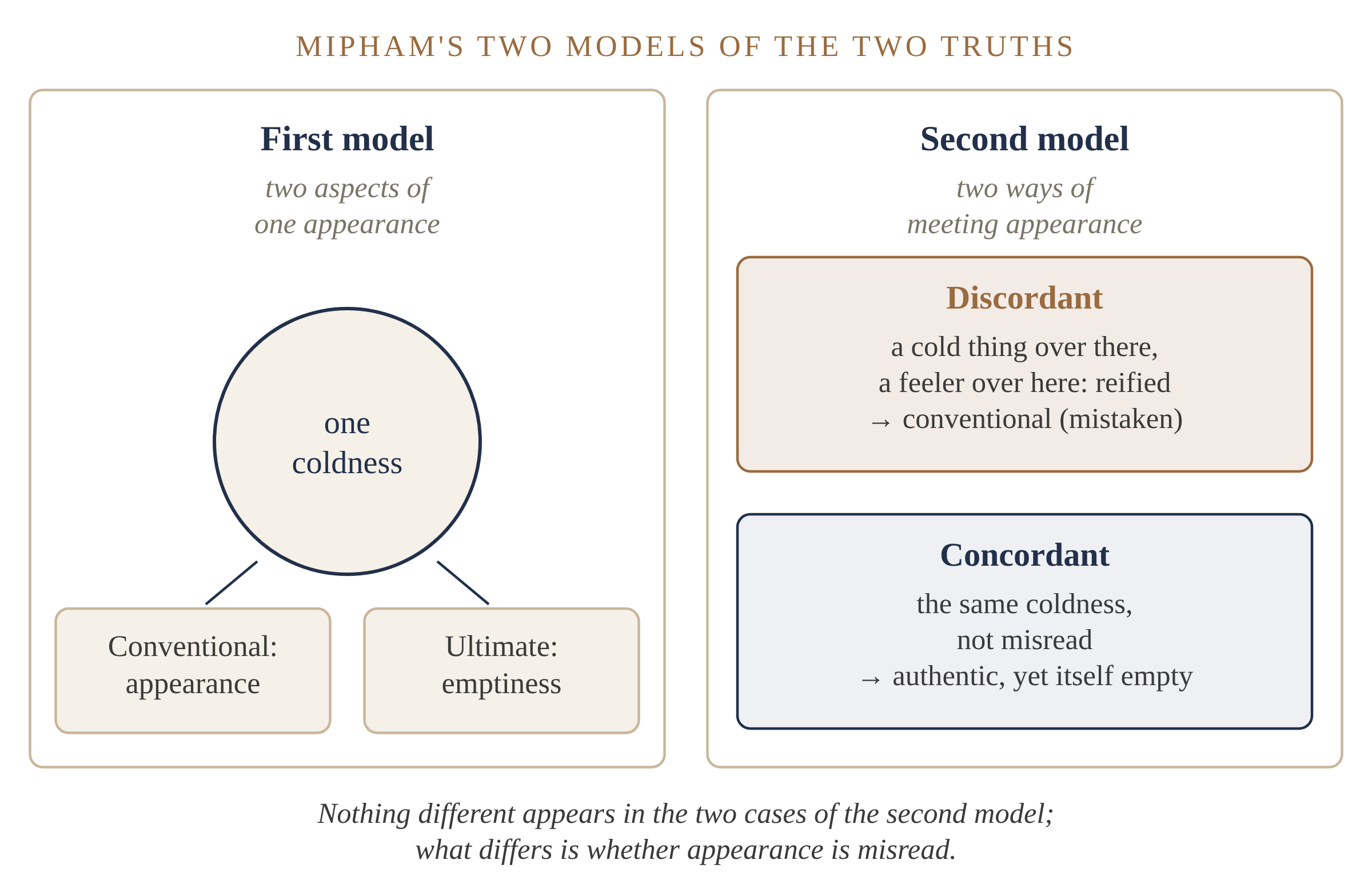
Figure 8. Mipham's two models of the two truths (after Duckworth 2008, 2010). In the second model the same appearance is met either with or without reification.
What is true of the coldness is true of the phone in your hand, the page you are reading, and the one who reads it. Each appears fully, functions reliably, and is found nowhere when sought. Each is one appearance, seen from two sides—and the seeing is available now, in the coldness of an ice cube, not only at the end of an argument.